
Business Technology Advisors
Digital Signage in Detroit, MI.
Wayne County manufacturing operations and automotive facilities need visual communication systems that withstand industrial environments while delivering clear information to workers across large floor spaces. QH displays handle production floors, warehouses, and facilities with bright overhead lighting or natural light from skylights and loading dock areas. Screen brightness differences matter when workers need to see safety alerts, production metrics, or shift schedules from 30-40 feet away in well-lit industrial spaces.
Manufacturing plants in Dearborn and Warren use large format displays for production dashboards. Healthcare facilities throughout Metro Detroit install them for patient wayfinding and wait time information. Corporate offices in downtown high-rises and suburban Troy manage internal communications through networked screen systems.
Automotive suppliers, healthcare networks, educational institutions, and corporate headquarters across Wayne County implement these systems for safety communications, operational metrics, and employee information distribution.
We Service
Retail Restaurants Hospitality Corporate Offices Healthcare Banking Schools Government
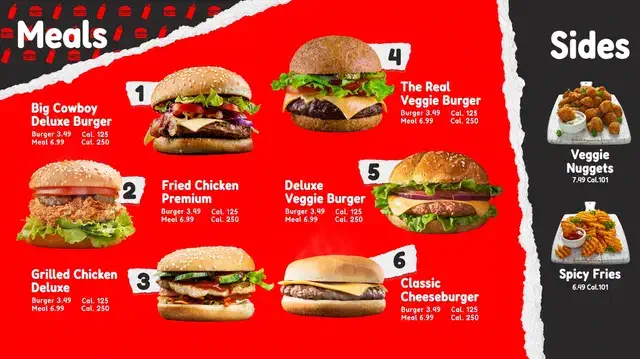
Digital Menus
Transform your Detroit restaurant or café with dynamic menu boards.
✓ Update pricing instantly
✓ Reduce wait times
✓ Increase check averages
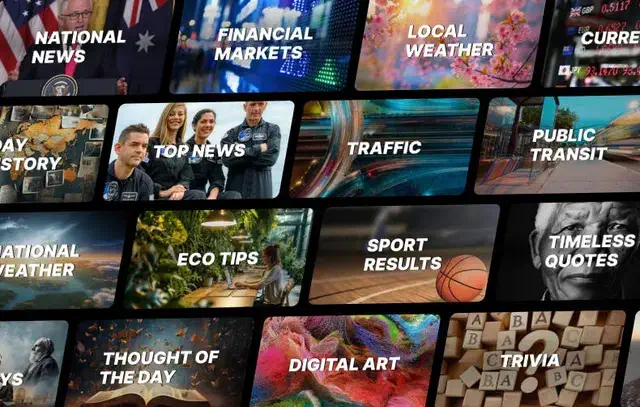
Info Displays
Information displays keep your space organized and standardize the experience across Michigan and any of your other locations.
✓ Wayfinding digital screens
✓ Emergency alerts
✓ Visitor management

Art Displays
Stand out with incredible showcases of rotating artwork or a digital marquee.
✓ Rotating galleries
✓ Branded content
✓ Atmosphere
Hardware & Software
Features
Synced Playback
Conditional Displays
Publish Date Control
Bulk Screen Setup
Preset Configurations
Auto-Dimming Timers
Proactive Alerts
Energy Use Monitors
What We Help With:
We help at every stage, at no extra cost. Let us know what you need and we’ll walk you through the rest. It doesn’t matter if you’re a small or enterprise size business, we partner with a large range of companies.
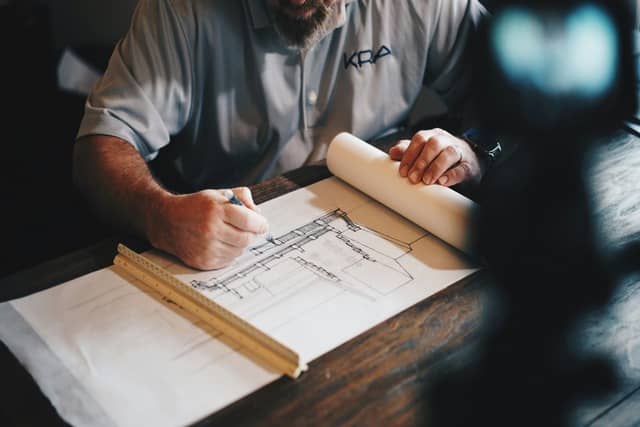
Planning
Purchasing
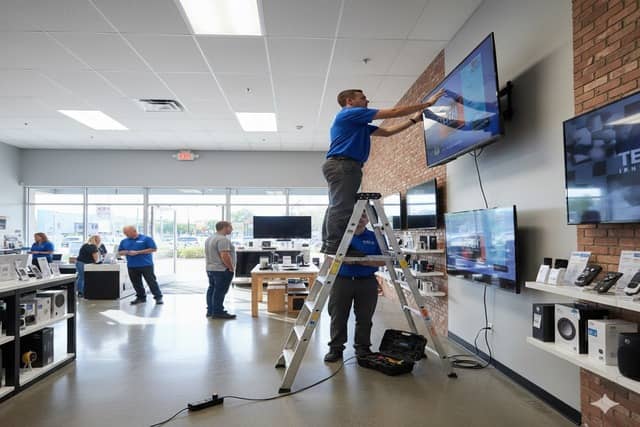
Installation
Detroit’s manufacturing sector uses commercial displays differently than corporate office environments. Production floors need real-time data visualization showing output rates, quality metrics, and safety statistics visible to entire teams simultaneously.
Healthcare systems like Henry Ford Health and Beaumont manage patient flow information across emergency departments and outpatient facilities. Universities including Wayne State control campus-wide emergency notifications and event information through centralized systems. Automotive facilities display shift schedules, safety protocols, and production targets that update based on actual floor conditions.
The technology integrates with existing data systems through APIs and database connections. Production information flows directly from manufacturing execution systems to floor displays without manual data entry. Patient wait times pull from hospital management software automatically.
Samsung provides local service throughout Metro Detroit for warranty support and technical issues. Commercial-grade components differ from consumer products in thermal management, power supply durability, and continuous operation capability.
Frequently Asked Questions (FAQ)
What is digital signage?
Digital signage is a screen that displays dynamic content instead of static printed signs. They are digital signs where you control what appears on the screen remotely through software, so you can update pricing, promotions, announcements, or visuals without printing anything or physically visiting the location. Common uses include restaurant digital menus, retail advert displays, lobby directories, and corporate communication screens.
How much do business displays cost?
It varies wildly depending on your needs, which is why we must do a consultation first. For Samsung commercial displays, expect $1,000 to $3,000 per screen depending on size and model. A 65″ QB series (350 nit, 16/7 rated) runs around $1,100 to $1,300. A 65″ QH series (700 nit, 24/7 rated) runs $1,700 to $2,000. Installation adds $200 to $400 per screen. Content management software like Samsung VXT starts at $10 per screen per month ($120 annually) for the S Series. Total cost for a single-screen setup typically ranges from $1,500 to $4,000. Our consulting and planning services are free. You only pay for hardware and installation.
Do I need a separate media player?
No. Samsung’s commercial displays have built-in Tizen processors that run content directly on the screen. You upload content through cloud software and the screen handles playback. This eliminates the need for external computers, media boxes, or USB drives. It also means fewer cables and fewer points of failure.
How long does installation take?
Typically 2 to 3 hours per screen. This includes mounting the display, running power, connecting to WiFi, configuring the software, and loading initial content. Multi-screen installations or complex setups like video walls take longer.
Can I update content myself?
Yes. Samsung VXT and similar platforms let you log in from any computer or phone to change what’s on screen. You can update text, swap images, adjust schedules, or push new content to multiple locations simultaneously. No technical expertise required. Most updates take less than five minutes. VXT is currently considered to be one of the best digital signage software in 2025/2026.
What's Samsung VXT?
Samsung VXT is Samsung’s cloud-based content management software. It lets you create, schedule, and deploy content to your displays from anywhere. Features include drag-and-drop content creation, automated scheduling, remote monitoring, and analytics on what content plays when. It integrates directly with Samsung’s commercial displays and requires no additional hardware.
What's the difference between a commercial display and a regular TV?
Commercial displays are built for extended operation (16+ hours daily), have higher brightness (350 to 500+ nits versus 200 to 300 nits for consumer TVs), include built-in content management, have no visible branding on the bezel, and carry commercial warranties. Consumer TVs are designed for 4 to 6 hours of daily home use and will fail quickly in commercial settings.
Do you service areas outside Detroit?
Yes. We install and support digital signage projects throughout North America. However, we have centralized support in specific cities around the US, like Detroit.
An automotive supplier in Warren needed better safety communication across their production facility. Safety briefings were conducted verbally at shift changes, and written protocols posted on bulletin boards rarely got read. When safety procedures changed, information took days or weeks to reach all shift workers consistently.
They positioned four Samsung QH75C displays at strategic points where workers naturally gathered during breaks and shift changes.
Safety teams now update protocols instantly across all displays when procedures change. Video demonstrations of proper techniques loop during break periods. The safety manager reports that workers actually watch the displays during downtime, something they never did with printed materials.
Incident rates related to procedure misunderstanding declined noticeably in the first six months. The facility plans to expand the system to show production metrics and quality data on the same screens.